
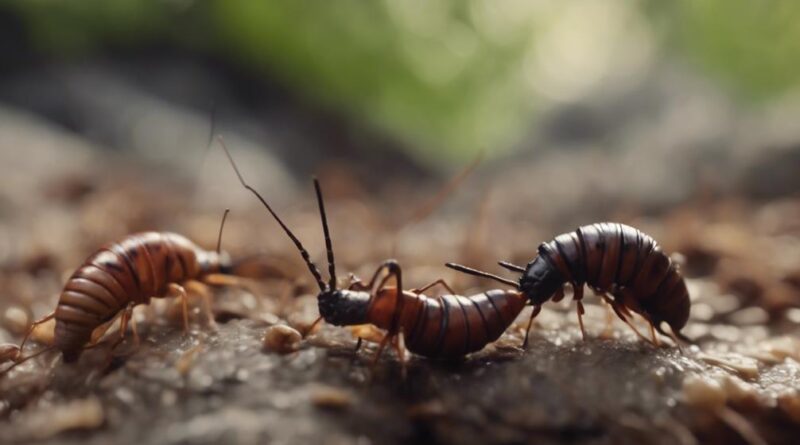
What Determines if Earwigs Are Social or Solitary?
Have you ever wondered what drives earwigs to be social or choose a life of solitude? It’s not just a simple matter of personality; a complex interaction of genetics, environment, and parental influence shapes these behaviors.
For instance, specific genes can predispose earwigs to seek company, yet environmental factors like resource availability can sway them towards social living or solitude. Additionally, the role of parental care, particularly in how mothers might affect their offspring’s social tendencies through microbial transfers, is fascinating.
This interplay might make you question how similar factors influence your own social behaviors. What do you think connects more with their social tendencies—genetics, environment, or parental upbringing?
Key Takeaways
- Genetic makeup influences whether earwigs exhibit social or solitary behaviors.
- Environmental conditions, such as habitat quality and resource availability, impact their social tendencies.
- Variations in parental care strategies play a significant role in determining social behavior.
- Phylogenetic relationships reveal distinct social or solitary behaviors among different earwig lineages.
- The microbiome, influenced by maternal care, affects the social behaviors of earwigs.
Genetic Predispositions
Genetic predispositions greatly influence whether earwigs adopt social or solitary behaviors. Specific genes are pivotal in shaping how these insects interact within their populations. These genetic factors are paramount in developing social structures, making each earwig species uniquely adapted to its form of community life or isolation.
As you explore further, variations in gene expression within these creatures markedly impact their propensity for social interactions. It’s not just about being social or solitary; these variations can dictate the complexity of their social behaviors. For example, certain genes might promote more cooperative behaviors, essential for survival in environments where teamwork offers a distinct advantage.
Moreover, earwigs’ evolutionary history plays a significant role in this genetic setup. Over millions of years, earwigs have evolved, with natural selection favoring specific genetic traits that support either social or solitary living, depending on environmental pressures and opportunities encountered by ancestral populations.
Thus, understanding the role of these specific genes and their expressions gives insight into the broader picture of earwig sociality. It’s a complex interplay of genetics that has been carefully shaped by evolutionary processes, shaping the diverse social landscapes observed in earwig species today.
Environmental Influences
While genetics set the stage for earwig social behaviors, the quality of their environment also plays a critical role in shaping whether they lean towards sociability or solitude. You’ll find that environmental factors such as habitat quality and resource availability are pivotal in deciding if earwigs will gather socially or lead solitary lives.
High-quality habitats with abundant shelter and food sources tend to support social interactions among earwigs. On the other hand, poor habitat quality often forces them into solitary behaviors to survive. Moreover, the population density in your area can greatly influence earwig social structures.
In densely populated areas, competition for resources might push earwigs to form social groups, enhancing their chances of survival. However, environmental disturbances like habitat destruction or sudden changes in food availability can disrupt these social bonds, resulting in more earwigs choosing a solitary lifestyle.
Factors such as temperature, humidity, and light exposure also weave into the complex tapestry, determining whether earwigs will socialize or isolate. Understanding these dynamics helps you see how subtly and significantly the environment impacts earwig behavior, pushing them between social and solitary behaviors based on external conditions.
Parental Care Impact
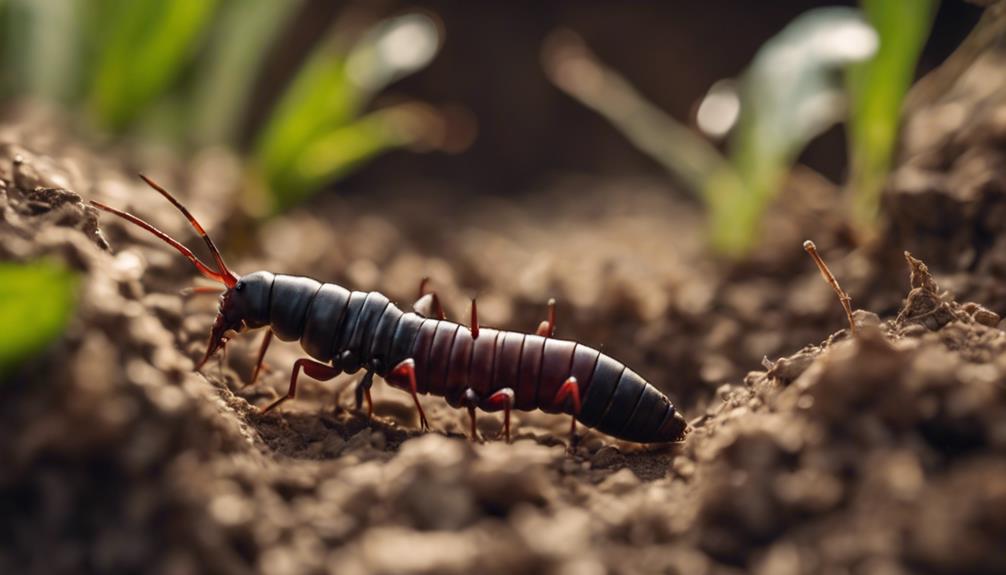
Parental care in some earwig species profoundly shapes their social behaviors. Females not only protect and groom their eggs but also influence their offspring’s microbial environment, impacting how they interact socially. When you observe these intriguing creatures, you witness a complex interplay of behaviors that guarantee their young thrive.
The maternal presence in the nest doesn’t just ward off predators or keep the eggs clean; it also enriches the microbiome, which is vital for fending off diseases and regulating physiological functions. This nurturing behavior directly correlates with enhanced offspring survival, as the eggs are shielded from environmental adversities and bathed in beneficial, anti-fungal bacteria. Here’s a quick breakdown of how these factors play out:
| Impact Area | Description |
|---|---|
| Microbiome Influence | Enrichment of anti-fungal and diverse bacteria species. |
| Offspring Survival | Increased protection and grooming boost survival rates. |
| Social Interactions | Parental care fosters early social behaviors in offspring. |
| Environmental Protection | Defense against temperature extremes and moisture loss. |
Aggregation Behavior
Earwigs often form groups in suitable habitats, showcasing a distinct pattern of aggregation behavior. Several factors influence this tendency. The availability of shelter, sex, body size, and varying environmental conditions play critical roles. It’s interesting how these elements dictate whether earwigs choose to live socially or solitarily.
As you explore further, you’ll notice that social interactions are integral to their aggregation behavior. Earwigs engage in cooperative care of their eggs and young, a behavior that emphasizes the importance of group living for survival and reproductive success. Chemical signals are important too; they facilitate communication within earwig populations, helping these insects identify when and where to aggregate.
Species variation further complicates the picture. Different earwig species respond uniquely to similar environmental factors, which alters their aggregation behavior. This species-specific response underlines the complexity of their social structure.
Microbiome Composition

Exploring further, you’ll find that the microbiome composition greatly influences whether earwigs exhibit social or solitary behaviors. In earwig species, variations in bacterial richness and the diversity of their microbiomes are closely linked to their behavioral tendencies.
Social earwigs, for instance, boast a core microbiome enriched with potentially beneficial bacteria. This core microbiome supports social behavior and contributes to microbiome stability, which is essential for maintaining their social structures. Moreover, maternal care plays a vital role in the transmission of microbiota among social earwigs.
Through maternal interactions, beneficial bacteria are passed from mother to offspring, ensuring that the next generation inherits a microbiome that fosters social behavior. This transmission dynamic is less pronounced in solitary earwigs, who don’t benefit from the same level of maternal involvement and, consequently, from the stable transmission of beneficial microbes.
Understanding these dynamics offers insight into how the microbiome composition directly impacts the life strategies of different earwig species, influencing whether they lean towards social or solitary behavior. This intricate relationship highlights the importance of the microbiome in shaping the social architecture of these fascinating insects.
Species Diversity
Delving into species diversity, you’ll uncover that their genetic makeup and environmental influences shape the range of social behaviors among earwig species. This species diversity is vital in determining the varied social structures you observe in earwigs. Thanks to their genetic predisposition, some species show complex social interactions, while others might opt for a more solitary existence.
The evolutionary history of earwigs plays a significant role here. This history, combined with ecological adaptations, has enabled different earwig species to develop unique social behaviors. For instance, the variations in social structure from one species to another can be quite stark, influenced heavily by inherited traits and the specific environmental conditions they face.
Moreover, studies focusing on sibling species within the Dermaptera order have shed light on the subtle genetic and behavioral nuances that dictate their social tendencies and interactions.
These sibling species, often similar in many respects, can exhibit dramatically different social behaviors, illustrating just how pivotal genetic differences are in shaping their social landscape. Understanding these dynamics helps you appreciate the complexity of social evolution in earwigs.
Phylogenetic Relationships

Phylogenetic studies reveal that various earwig lineages independently evolved distinct social behaviors. These studies reveal fascinating insights into how the evolutionary history and genetic relatedness among species influence their social interactions.
This understanding is important as it highlights the complex nature of earwig social structures, which vary greatly even among closely related species. These differences can primarily be seen in their mating systems and parental care strategies. For instance, some earwig species exhibit high levels of parental care, which is closely tied to their sociality level.
Others might display more solitary behaviors, bypassing the extensive care seen in their counterparts. Genetic analyses help map out these behaviors, showing a clear link between genetics and social traits. To get a clearer picture, consider these key points:
- Parental Care: Variations in this trait are pivotal in determining the social behaviors of earwigs.
- Mating Systems: Different systems influence the social structure and interaction within earwig populations.
- Genetic Analyses: These provide insights into the evolutionary pathways that have shaped the current social behaviors of earwigs.
Understanding these phylogenetic relationships helps unravel the complex web of factors that govern whether earwigs are social or solitary.
Conclusion
You’ve seen that earwigs’ social or solitary nature hinges on a mix of genetics, environment, and parental care. Genes set the stage, but the quality of their habitat and the availability of resources often dictate their social interactions. Disruptions in these can push them towards solitude. Additionally, the care earwigs receive from their parents, particularly mothers, boosts their social skills and their chances of survival by enhancing their microbiome.
Discover More Articles:
Are Elephant Mosquitoes Dangerous? What You Need to Know
Ant Anatomy: Exploring the Internal Organs of Ants
Do Insects Have a Nervous System? A Deep Dive into Insect Biology
