

Caterpillar Larvae: Common Types and Their Habitats
When you consider caterpillar larvae, you might first notice their striking colors and patterns, but there’s much more beneath the surface. These fascinating creatures possess unique features like prolegs and true legs, which help identify them. As they grow, caterpillars undergo several molts, shedding their exoskeletons in stages called instars.
Their defense mechanisms, from urticating hairs to aposematic coloring, play essential roles in their survival. But have you ever wondered how these larvae fit into the larger ecosystem? There’s an intricate balance at play that you might find intriguing.
Key Takeaways
- Caterpillar larvae exhibit diverse colors, patterns, and sizes for survival and ecosystem contribution.
- Growth involves multiple molts through stages called instars, with intense feeding between each stage.
- Defense mechanisms include urticating hairs, aposematic coloring, and chemical defenses to deter predators.
- Caterpillars play crucial roles in ecosystems by regulating plant populations and serving as a food source.
- Common species include drinker moth, fox moth, pine processionary, spurge hawk-moth, and private hawk moth caterpillars.
Identification and Characteristics

Caterpillar larvae, the immature stage of moths and butterflies, exhibit various colors, patterns, and sizes, making them fascinating to identify. When trying to identify these larvae, you’ll notice the unique characteristics that set them apart from other insect larvae.
One key feature is their prolegs, which are smaller and found on specific abdominal segments. In contrast, their true legs are located near the head. The appearance of caterpillars can vary dramatically. Some display vibrant colors and intricate patterns, while others blend seamlessly into their surroundings.
Body hairs are another distinctive trait; they can be sparse or dense and sometimes even serve as a defense adaptation to deter predators. Additionally, markings on the body can range from spots and stripes to more complex designs, aiding in identification.
Caterpillars play a significant role in ecosystems by consuming plant material and providing a food source for various animals. Their diverse appearances and adaptations help them survive and contribute to the intricate balance of their habitats. Recognizing these features can make identifying caterpillar larvae an engaging and educational experience.
Growth and Molting
As larvae grow rapidly, they must molt their exoskeletons multiple times to keep up with their increasing size. This process, known as molting, is essential for caterpillars. During each molt, they shed their old exoskeleton to reveal a larger one underneath, allowing further growth and development.
Caterpillars go through several stages of growth called instars. Between each instar, there’s a period of intense food consumption. They need to eat large amounts of food to fuel their rapid growth. The energy from this food is vital for their development, as it enables the larvae to increase in size significantly between each molt.
As the larvae grow, their exoskeleton becomes too tight and must be shed. This shedding process can happen multiple times throughout the caterpillar’s life cycle. Each new exoskeleton that emerges is more spacious, accommodating the caterpillar’s larger size.
Understanding the molting process is key to appreciating how caterpillars develop. They continuously grow and evolve, driven by their need to consume food and shed their exoskeletons. This cycle of growth and molting is a fascinating aspect of their life that underscores the complexity of their development.
Defense Mechanisms
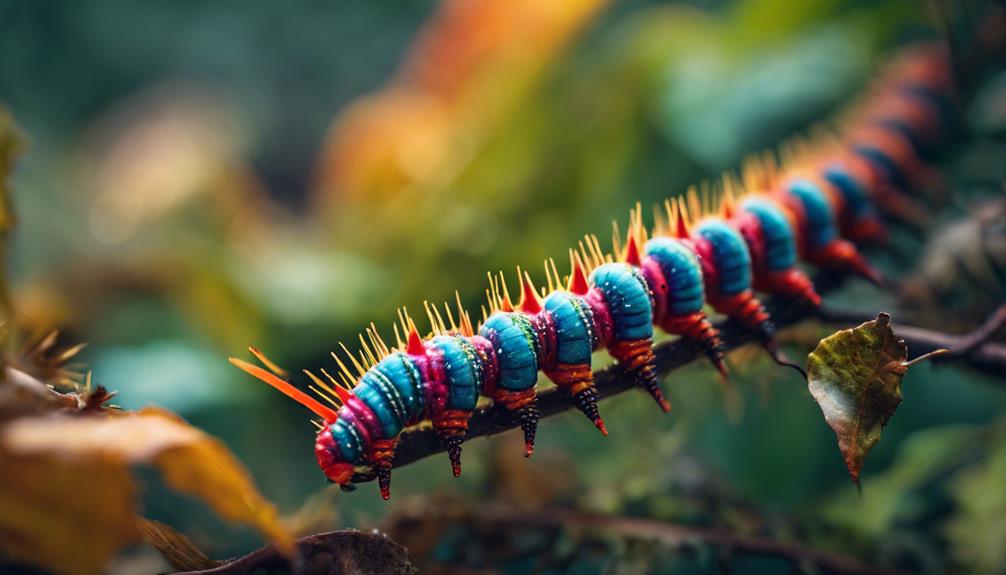
Many larvae have evolved ingenious defense mechanisms to deter predators, like urticating hairs and aposematic coloring. These adaptations make them less appealing or more dangerous to potential threats. For instance, urticating hairs can irritate predators’ skin, while aposematic coloring warns them of the larvae’s toxicity. Here are three fascinating defense mechanisms larvae use:
- Chemical Defenses: Some larvae possess toxins or spines that can deter or harm predators. These toxins may be inherent or acquired from their host plants, making them a risky meal.
- Behavioral Defenses: Many larvae engage in behaviors like regurgitating digestive juices, which can repel predators. Some also adopt nocturnal feeding habits to avoid being seen by daytime hunters.
- Social Behaviors: Certain larvae form associations with ants or other insects for protection. Group behaviors, such as clustering together, can also enhance their chances of survival.
You’ll also find that some caterpillar species exhibit predatory behavior themselves, turning the tables on potential threats. By employing these diverse defense mechanisms, larvae greatly improve their odds of reaching adulthood despite their myriad dangers.
Role in the Ecosystem
You’ll find that caterpillar larvae play a pivotal role in the ecosystem by serving as primary consumers in food chains. They regulate plant populations by voraciously feeding on leaves and other plant material. This activity influences plant growth and diversity, maintaining a balance in various habitats.
Through feeding, larvae contribute greatly to nutrient cycling, breaking plant matter into organic material that enriches the soil. Caterpillar larvae also serve as a critical food source for many predators, including birds, insects, and small mammals. This supports higher trophic levels in the ecosystem and promotes a dynamic energy flow through food chains.
The presence of larvae can thus indicate an ecosystem’s health and stability. Moreover, some caterpillar larvae engage in mutualistic relationships with ants, offering sweet secretions in exchange for protection. These interactions highlight the complex ecological relationships that caterpillars partake in, extending their influence beyond mere consumption.
Common Species

Caterpillar larvae come in diverse species, each with unique characteristics that make them fascinating to observe and study. Among these, the Drinker moth caterpillars and Fox moth caterpillars stand out with their distinct appearances. Drinker moth caterpillars, found from August to June, grow up to 7 cm long and feature dark bodies adorned with brown hairs and golden speckles.
Fox moth caterpillars, commonly seen in spring, also reach up to 7 cm and have a hairy look, with long dark hairs on the sides and shorter orange hairs on top. Some caterpillar species exhibit remarkable behaviors and traits. For instance, the spurge hawk-moth caterpillar, privet hawk-moth caterpillar, and emperor gum moth caterpillar each display unique characteristics, adding to the rich diversity of caterpillar species.
Meanwhile, the cotton bollworm caterpillar is infamous for causing severe crop damage, emphasizing the economic significance of certain caterpillar species. Notably, pine processionary caterpillars are fascinating for their social behaviors, forming long trains as they move. Here are three engaging examples:
- Drinker moth caterpillars: Dark with brown hairs and golden speckles.
- Fox moth caterpillars: Hairy with dark and orange hairs.
- Pine processionary caterpillars: Form long, moving trains.
Conclusion
You’ve now explored the fascinating world of caterpillar larvae. By recognizing their distinct features, understanding their growth through molting, and appreciating their clever defense mechanisms, you can see how essential they are to ecosystems. These primary consumers contribute to food chains and maintain natural balance.
Remember, every colorful, patterned caterpillar you spot plays an important role in nature’s intricate dance. Keep curious and protect these incredible creatures!
