

The Secret Life of Gall Wasps: Small Wonders of the Insect World
When you think about insects that critically impact the environment, gall wasps might not be the first to come to mind, but they deserve a closer look. These tiny creatures form galls on plants, manipulating plant tissues to create unique habitats and nutrient sources.
This process is fascinating and plays an important role in various ecosystems. Even more intriguing is their evolutionary dance with host plants, a partnership that has evolved over millions of years. But how exactly do these wasps manage such complex interactions? Let’s explore further.
Key Takeaways
- Gall wasps induce distinctive plant galls, which are crucial for their lifecycle and larval development.
- Oak gall wasps primarily reproduce via parthenogenesis, ensuring a stable population of host plants.
- Gall wasps’ lifecycle includes egg laying, larval growth inside galls, and adult emergence.
- Parasitoids and hyperparasitoids disrupt the gall wasps’ lifecycle by preying on larvae within galls.
- Gall wasps have cultural significance, contributing tannic acid for inks, dyes, and leather tanning.
Features

Gall wasps have a distinctive body shape with a wasp waist and an abdomen that forms a petiole and gaster. When you examine oak gall wasps, a subgroup within the Cynipidae family, you’ll notice their unique physical characteristics.
These tiny insects, usually black and shiny, measure around 6 to 8 mm long. Their thorax is sculpted, while their wings are structured and often transparent.
One striking feature is their longitudinally banded mesosoma, which adds to their distinctive look. Their antennae are straight and segmented, and females possess an egg-depositing ovipositor.
This ovipositor plays a significant role in their ability to interact with plant tissue, particularly oak trees, where they induce the formation of galls.
Galls are growths that form on plant tissue, providing both food and shelter for the developing wasp larvae. Interestingly, male gall wasps are rare, and most reproduction happens via parthenogenesis, where females produce offspring without mating.
This fascinating reproductive strategy ensures a steady population, allowing these unique insects to thrive on their preferred plant hosts.
Lifecycle
Understanding their lifecycle reveals how these wasps interact with their environment and ensure survival. Female gall wasps lay their eggs into plant tissue, kickstarting the fascinating process of gall formation.
When the eggs hatch, the larvae secrete substances that cause abnormal plant tissue growth, resulting in the distinctive galls you often see on plants.
Inside these galls, the larvae find a haven and an abundant food source as they feed on the plant tissue. This phase continues until they pupate and transform into adult wasps.
Gall wasps exhibit parthenogenic reproduction, which is noteworthy as it means they can produce offspring from unfertilized eggs. This reproductive strategy plays a significant role in their lifecycle, ensuring that even a single female can perpetuate the species.
Gall wasps also show alternating generations involving both two-sex and parthenogenic generations. This alternation adds another layer of complexity to their lifecycle, allowing them to adapt and thrive in various environments.
Here’s a simplified table to help visualize their lifecycle:
| Stage | Activity | Description |
|---|---|---|
| Egg | Laid in plant tissue | Initiates gall formation |
| Larvae | Secretes substances | Causes abnormal plant tissue growth |
| Adult Wasp | Emerges from gall | Capable of parthenogenic reproduction |
Understanding these stages helps you appreciate the intricate lifecycle of gall wasps.
Parasitism
Parasitism in gall wasps is a fascinating interaction where parasitoids lay their eggs on the developing larvae inside the protective gall. These tiny invaders use a specialized tool called an ovipositor, which is long and hardened, to penetrate the gall and reach the vulnerable larvae.
This process disrupts the life cycle of the gall wasps, as the parasitoid larvae eventually consume the host.
You’ll often find that gall formation is a defensive mechanism to shield the developing larvae from such threats. However, parasitoids have evolved to overcome these defenses. The ovipositor isn’t just a laying tool but a weapon that can pierce through the gall’s protective layers.
Here’s what you can picture:
- A parasitoid wasp hovers near a gall, ready to strike.
- The ovipositor slowly penetrates the gall, reaching the hidden larvae.
- Even more specialized hyperparasitoids prey on the initial parasitoids within the gall.
Parasitism adds a complex layer to the gall wasp’s life, highlighting the intricate dynamics of nature’s food web. It’s a constant battle for survival where even protective structures like galls aren’t foolproof.
Gall Types
When exploring the variety of galls induced by wasps, you’ll notice how each type has a distinct shape and structure unique to its species. Oak gall wasps, for example, are notorious for the diverse types of galls they produce on oak trees.
One common type of gall is the oak apple gall, caused by the larvae of Biorhiza pallida. These galls are large and round and often house multiple larvae.
Another fascinating type of gall is the marble gall, induced by Andricus Kollari. These galls are smaller, hard, and have a smooth, marble-like appearance.
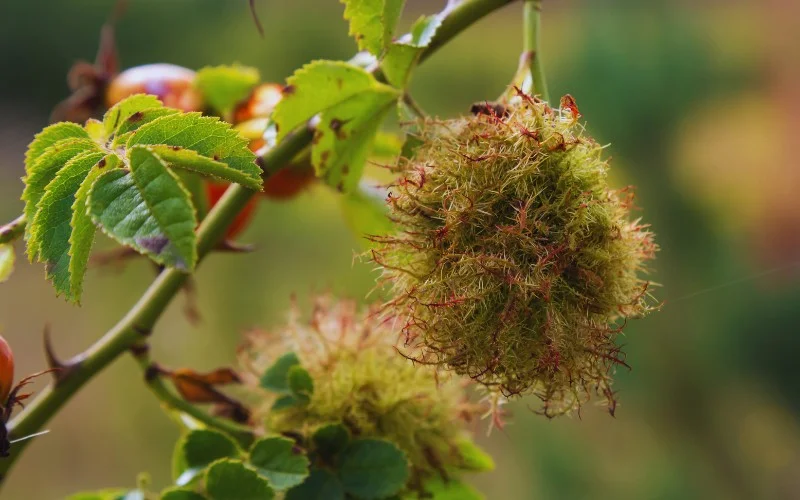
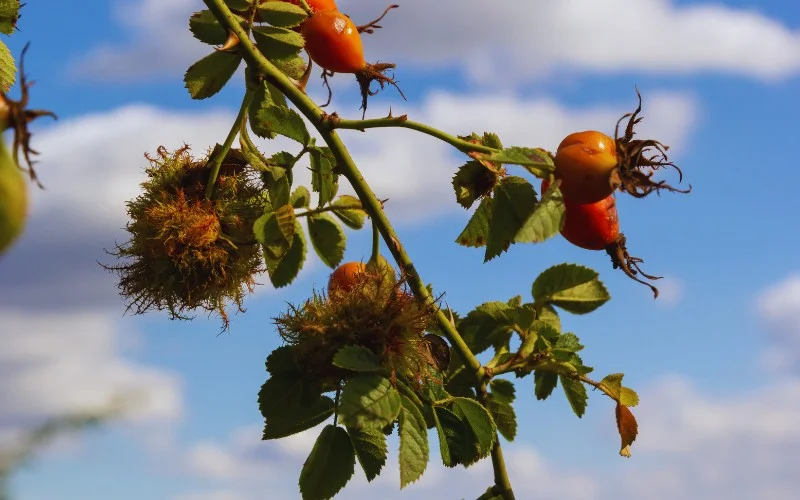
In contrast, the bedeguar gall, produced by Diplolepis rosae, looks like a fuzzy, star-shaped mass and typically grows on rose bushes.
The galls produced by various wasp species can vary significantly in appearance. Some are spherical, while others might be star-shaped or even spiky.
This diversity extends beyond aesthetics, as each type of gall plays an important role in the lifecycle of the inducing wasp. Historical uses of these galls, like producing tannic acid for inks and dyes, highlight their importance beyond just a biological curiosity.
Understanding these differences helps you appreciate the complex relationships between gall wasps and their host plants.
Evolutionary History
Frequently overlooked, gall wasps’ evolutionary history reveals a complex tapestry shaped by their diverse tribes and intricate relationships with host plants. By understanding this history, you’ll appreciate how these fascinating insects have adapted and diversified over millions of years.
Based on Peters et al. (2017), external phylogeny provides a broad look at how gall wasps fit within the larger group of Apocrita, which are part of the Sawflies group.
On the other hand, Hearn et al. (2023) conducted molecular analyses exploring the internal phylogeny, offering insights into the relationships within and between tribes such as Aylacini, Ceroptresini, and Cynipini.
- Diverse tribes like Diastrophini, Eschatocerini, and Phanacidini reveal various evolutionary paths.
- Oak gall wasps, part of the Cynipini tribe, show an intricate relationship with oak trees.
- Plant galls themselves are proof of the co-evolution of gall wasps and their host plants.
These evolutionary developments underscore how gall wasps have specialized over time. They’ve created unique niches by forming plant galls essential for their survival and reproduction. Their evolutionary history isn’t just a tale of survival—it’s a story of intricate relationships and mutual adaptations.
Ecological Impact
Gall wasps’ remarkable ability to induce galls on plants greatly alters the local ecosystem, impacting plant physiology and nutrient distribution. When oak gall wasps form galls on oak trees, they create unique microhabitats that affect how the plant allocates resources.
Galls reroute nutrients, often concentrating them in the gall tissue itself. This nutrient allocation can stunt the growth of other parts of the plant, affecting its overall health and vigor.
In plant-insect interactions, oak gall wasps play a pivotal role. By inducing galls, they provide a habitat for their larvae and influence the broader ecological network.
These galls can attract other insects, including predators or parasites of the gall wasps, creating a complex web of relations. Additionally, some galls may offer the host plant certain benefits, such as protection from herbivores that prefer other parts of the plant.
The diversity of galls produced by these wasps reflects their intricate relationships with plant species. Each type of gall represents a specific interaction between the wasp and its host plant, showcasing the ecological impact of these tiny architects.
Cultural Significance
Have you ever wondered how some tiny insects could leave such a significant mark on human culture and history? Oak gall wasps have done just that.
By inducing abnormal growths on plants known as galls, these minute creatures have woven themselves into the fabric of various cultures. Historically, some galls, like oak apples and marble galls, were highly valued for their practical uses.
- The production of tannic acid is essential for leather tanning.
- The creation of inks is vital for historical manuscripts.
- The development of dyes is significant for textile coloring.
These uses highlight the remarkable cultural importance of gall wasps. Beyond practicality, the diversity and uniqueness of these galls have inspired scientific research and artistic interpretations.
Their intricate structures and complex relationships with host plants, particularly oaks, have fascinated scientists and artists alike. Studying these galls has even spurred conservation efforts to protect their natural habitats.
In various regions, oak gall wasps and their galls have rich cultural histories, reflecting the deep connection between nature and human ingenuity. So, next time you see an oak tree, remember the tiny insects that have greatly impacted our cultural heritage.
Conclusion
You’ve journeyed through the fascinating world of gall wasps, witnessing their unique features, complex lifecycles, and diverse gall types. You’ve seen how they’ve co-evolved with plants, impacting ecosystems and sparking scientific and cultural interest.
Gall wasps aren’t just insects; they demonstrate the intricate web of life, showcasing nature’s creativity and resilience. So, next time you spot a gall, remember the tiny architects behind it and the rich history it carries.
Explore More Articles:
Exploring the Mystique of the Atala Butterfly: Fluttering Grace
Home Remedies for Earwig Infestation: Effective Natural Solutions
