

The Class Characteristics Habits And Traits Of Chilopoda
As you explore the world of Chilopoda, you’ll find that centipedes are not just the creepy crawlies of your nightmares but fascinating creatures with specialized adaptations. Their elongated bodies, equipped with numerous pairs of legs, enable swift movements, which is essential for hunting.
Each segment of their body houses a pair of these legs, perfectly designed for their predatory lifestyle. Beyond their physical prowess, centipedes use venomous fangs to immobilize prey—a feature that’s as intriguing as it is challenging. But there’s more to their story than just hunting tactics. How do these characteristics play a role in their survival and survival in the ecosystem? Let’s explore further.
Key Takeaways
- Chilopoda, commonly known as centipedes, have elongated, segmented bodies with a single pair of legs per body segment.
- They possess venomous fangs used for immobilizing and tearing apart their prey.
- Centipedes display varied leg counts, with Scolopendrid species having 21-23 pairs and Earth Centipedes having over 31 pairs.
- These creatures are primarily predatory, feeding on invertebrates and occasionally exhibiting cannibalistic behavior.
- Centipedes use their last pair of legs for defense. These legs are often brightly colored and strong, serving as a warning to potential predators.
Physical Description
Like centipedes, chilopoda boast many physical features, from their strong, eye-catching rear legs to their elongated, segmented bodies with poisonous fangs. Each segment of their bodies, except for the head and last two, supports a single pair of legs, essential for their swift, predatory lifestyle.
You’ll find that these creatures have a staggering number of leg pairs, varying greatly across different species. For instance, the robust Scolopendrid centipedes flaunt 21-23 pairs of legs. Their last pair of legs is particularly longer and thicker, a critical adaptation for mobility, capturing prey, and self-defense.
These legs often stand out due to their size and strength, making them a distinctive feature in the centipede’s physical arsenal. On the other hand, Earth Centipedes, which are more slender and elongated, possess over 31 pairs of legs—this abundance of legs aids in their swift burrowing and navigation through their underground habitats.
While not as dramatically enhanced as in Scolopendrids, their last pair of legs still plays an important role in their survival strategies, blending seamlessly with their elongated bodies to support their stealthy lifestyle.
Habitat and Distribution
Centipedes excel in various environments, from damp underground burrows to arid desert landscapes. They are worldwide and adaptable to almost any habitat where moisture can be found. Their ability to inhabit under rocks, logs, bark, soil, and leaf litter makes them incredibly versatile.
Each species is equipped with numerous pairs of legs, assisting them in traversing these diverse terrains effectively. Some centipedes even make their homes around your dwelling, adjusting well to urban environments. Their proximity to humans shows their remarkable adaptability and resilience in various settings.
Earth centipedes, recognizable by their long, slender bodies and more than 31 pairs of legs, prefer moist habitats where they can maintain their necessary hydration levels. Their wide distribution doesn’t stop at moist areas; some centipedes have adapted to life in deserts, where they find and retain moisture efficiently.
Centipedes in temperate forests or tropical rainforests across different continents showcase a broad adaptability in habitat preferences. This flexibility in choosing habitats allows them to survive and thrive in conditions ranging from wet to dry, demonstrating their ecological versatility.
Diet and Hunting Methods

Predatory by nature, centipedes primarily hunt and consume invertebrates like spiders and insects. Armed with venomous fangs beneath their head, they’re not just creepy crawlers but efficient predators. These fangs and strong mandibles allow them to immobilize and tear apart their prey.
It’s not just the small bugs that need to be warned; some centipedes can take on small vertebrates, making their diet diverse and formidable. You might find it disturbing or fascinating, but centipedes also engage in cannibalistic behaviors when food is scarce. Their ruthless survival tactics include consuming other centipedes, slaters, and mollusks.
Each pair of their multitude of legs not only supports rapid movement but also aids in hunting, enabling them to capture and overpower their meals swiftly. Here’s how their diet impacts the ecosystem:
| Prey Type | Impact on Ecosystem |
|---|---|
| Insects & Spiders | Control overpopulation, reduce pest numbers |
| Small Vertebrates | Affect smaller fauna populations |
| Other Centipedes | Regulate their own species’ numbers |
| Molluscs & Slaters | Influence the soil composition and health |
Their role is vital, maintaining their habitats’ delicate balance through predatory practices.
Reproductive Behavior
Regarding reproduction, male centipedes deposit sperm packets on webs that females later collect. This unique method is a fascinating aspect of their reproductive behavior. You might find it intriguing that there’s more to mating in some species than just sperm transfer.
These creatures often engage in intricate courtship dances or perform a series of antennae taps to woo their partners. This behavior not only strengthens the bond between mating pairs but also plays an important role in centipedes’ reproductive success.
After the courtship rituals and successful sperm transfer, female centipedes lay their eggs in secure, hidden environments such as under rocks, logs, or within the soil or bark. You’d find something else interesting: female centipedes aren’t just prolific layers; they’re also attentive mothers.
Many species carefully brood their eggs, guarding them against predators and ensuring a moist environment to facilitate successful hatching. Once hatched, the young centipedes may already look like miniature versions of their parents, but they’ll undergo several molts, gaining more legs as they grow into adults. This gradual yet fascinating development is a remarkable journey in the life cycle of centipedes.
Defense Mechanisms
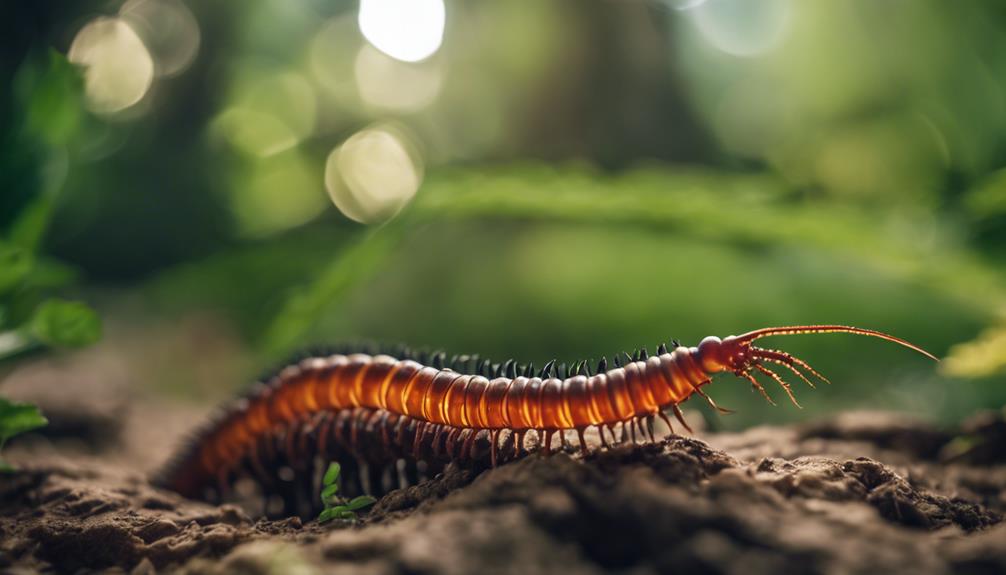
To defend themselves, centipedes use their modified fangs to inject venom into predators, causing pain and irritation. This venom deters larger threats and can immobilize smaller adversaries, making them easier to escape from or subdue. In some species, the last pair of legs plays an essential role beyond mobility.
These legs are often brightly colored and used in defensive displays to warn potential predators of the centipede’s harmful capabilities. Moreover, the robust Scolopendrid centipedes, which you might encounter measuring between 5-10 cm, have particularly strong and thick last pair of legs.
These aren’t just for show; they are powerful tools for grasping during fights and self-defense. When threatened, these centipedes can use their last legs to grip onto predators, leveraging their strength to fend off attacks.
Role in Ecosystems
Centipedes significantly impact their environments by controlling the populations of other arthropods and small vertebrates. As you explore their role, you’ll find that these creatures aren’t just creepy crawlers but essential ecological players. According to the Animal Diversity Web, centipedes are key predators in many terrestrial ecosystems.
They help manage insect numbers, preying on pests that could otherwise damage crops and natural vegetation. You mightn’t see them often, but centipedes are hard at work beneath the surface. Their venomous bites, a tool for subduing prey, signify their role in the food web.
By maintaining a balanced ecosystem, centipedes ensure the survival of various plant and animal species. Targeting insects and small vertebrates prevents overpopulation and the potential devastation of resources. Moreover, their predatory activities contribute to nutrient cycling, breaking down invertebrate populations and enriching the soil.
This not only supports plant life but also sustains biodiversity by allowing a multitude of species to flourish. So, next time you spot a centipede, remember you’re looking at a key contributor to ecological health and diversity.
Conclusion
You’ll marvel at their adaptability and prowess as you explore the world of centipedes. Centipedes are predators, from their elongated bodies with numerous legs to their venomous fangs. Their complex mating dances and maternal instincts add depth to their behavior, while their defensive capabilities protect them in diverse environments.
Understanding their role in controlling insect populations highlights their importance in ecosystems. So, appreciate these fascinating creatures’ unique contributions to our natural world.
Explore More Articles:
Difference Between Alcon Blue and Other Species Explained
What Do Earwigs Eat? Insights and Actions to Protect Your Garden
Why Use Natural Methods to Repel Earwigs? Safe and Sustainable
