

Difference Between Alcon Blue and Other Species Explained
When you look at the Alcon blue butterfly, you’re not just seeing another pretty insect; you’re witnessing a fascinating example of coevolution. Unlike its relatives, the Alcon blue has a unique, almost exclusive relationship with the Marsh Gentian plant, making it highly specialized and vulnerable.
This dependency isn’t just a botanical curiosity—it plays an essential role in the butterfly’s life cycle and survival strategies. So, what sets this delicate creature apart from other large blue butterflies, and why does it matter for conservation efforts? Let’s explore this intricate web of interactions.
Key Takeaways
- Alcon Blue relies on Marsh Gentian as its primary larval food source, unlike other blue butterfly species.
- Alcon Blue displays specific coevolutionary relationships with certain plants, distinguishing it ecologically.
- Alcon Blue larvae use chemical cues to mimic ant larvae and integrate into ant nests, a unique survival strategy.
- Migration patterns of Alcon Blue are highly localized and linked to the availability of essential host plants and ants.
- Alcon Blue flourishes in wet habitats like marshes and damp meadows, whereas other species may prefer different environments.
Species Description of Alcon Blue

The Alcon blue butterfly, belonging to the Phengaris genus, stands out from other large blue butterflies, which are classified under the Maculinea genus. One of the most notable differences is their host plant preference. The Alcon blue butterfly relies on the Marsh Gentian as its primary larval food source.
This specific plant choice highlights a unique coevolutionary relationship, unlike other large blue butterfly species that might utilize different plants. The Alcon blue butterfly exhibits distinct behaviors and life cycle adaptations, which are part of what makes its conservation so essential.
Being classified as endangered, the Alcon blue requires targeted butterfly conservation efforts to guarantee its survival. This status sets it apart from some other large blue butterfly species, which may not be as threatened. Understanding these differences is vital for effective conservation strategies.
Efforts need to focus on preserving the specific host plants and habitats required by the Alcon blue. By doing so, you contribute to maintaining the delicate balance of their ecosystem and support the conservation of this unique species. The Alcon blue butterfly’s specific needs and behaviors underscore the importance of tailored conservation measures.
Geographic Distribution
When you consider the geographic distribution of Alcon blue butterflies, you’ll notice they inhabit specific regions in Europe and Northern Asia. Their presence is tightly linked to the availability of suitable habitats and the presence of essential host ants. Unlike other large blue butterfly species, Alcon blues have unique migration patterns and environmental preferences that shape their distinct geographic range.
Native Habitat Range
Picture a vibrant butterfly fluttering across Europe, western Siberia, and Kazakhstan—you’re looking at the Alcon blue. These butterflies are primarily found in diverse shrubbery areas and pastures within the Palearctic domain. The Alcon blue has specific habitat requirements that make its native habitat range quite distinctive.
They rely on the presence of larval food plants like Thymus drucei and the Myrmica sabuleti ants, which play an essential role in their life cycle. Without these vital elements, the Alcon blue can’t thrive. Unfortunately, the Alcon blue has faced significant population declines, leading to their extinction in certain regions such as the Netherlands and the UK.
The loss of suitable habitats and the decline of essential plants and ants have contributed to their dwindling numbers. Conservation efforts are now more vital than ever to protect and preserve the remaining populations of Alcon blue butterflies.
These efforts aim to restore and maintain the Alcon blue’s native habitat range, ensuring that the specific habitat requirements are met. By focusing on these conservation measures, we can hope to see the Alcon blue continue to flutter through its natural habitats for generations to come.
Migration Patterns
While understanding the native habitat range of Alcon blue butterflies is important, it’s equally fascinating to learn about their migration patterns within these regions. Unlike some butterfly species that engage in long-distance seasonal movements across continents, Alcon blue butterflies display localized migration.
This means they shift between suitable habitats within a specific region in Europe, rather than traveling vast distances. Their migration patterns are closely linked to the availability of suitable larval food plants and host ant colonies in their specific habitat. These ecological requirements play a critical role in determining where they can successfully move.
You won’t find Alcon blue butterflies undertaking broad, unrestricted migration; their movements are confined to areas that meet their specific needs. Compared to other species with widespread migratory behaviors, Alcon blue butterflies exhibit a highly specialized form of localized migration.
Their limited migration ensures they remain within regions where their ecological requirements, such as the presence of specific larval food plants and host ant colonies, are fulfilled. This makes their migration patterns unique and emphasizes the delicate balance they maintain with their environment. Understanding these migration patterns offers valuable insight into the complexities of their survival and adaptation.
Environmental Preferences
Alcon blue butterflies flourish in moisture-loving habitats across specific regions of Europe, displaying a clear preference for wet environments. You’ll find them in wetlands, damp meadows, and marshes, where their ecological needs are fulfilled. Their geographic distribution is quite diverse, reflecting ecological variations across populations in different European countries.
These butterflies are often documented in areas with high parasitization rates, which can impact their populations. This makes conservation efforts necessary to safeguard their unique environmental preferences. Protecting their habitats is vital, as it helps maintain the delicate balance needed for their survival.
Given the varied geographic distribution and ecological diversity, genetic studies are recommended to explore potential hidden speciation within Alcon blue butterfly populations. Understanding these genetic differences can assist in developing targeted conservation strategies.
You’ll notice that conservation efforts focus on preserving moisture-loving habitats to guarantee the butterflies can thrive. By maintaining these wet environments, we can help sustain their populations despite the challenges posed by parasitization rates. This approach not only protects Alcon blue butterflies but also supports the broader ecosystem, benefiting other species reliant on similar habitats.
Life Cycle and Behavior of Alcon Blue
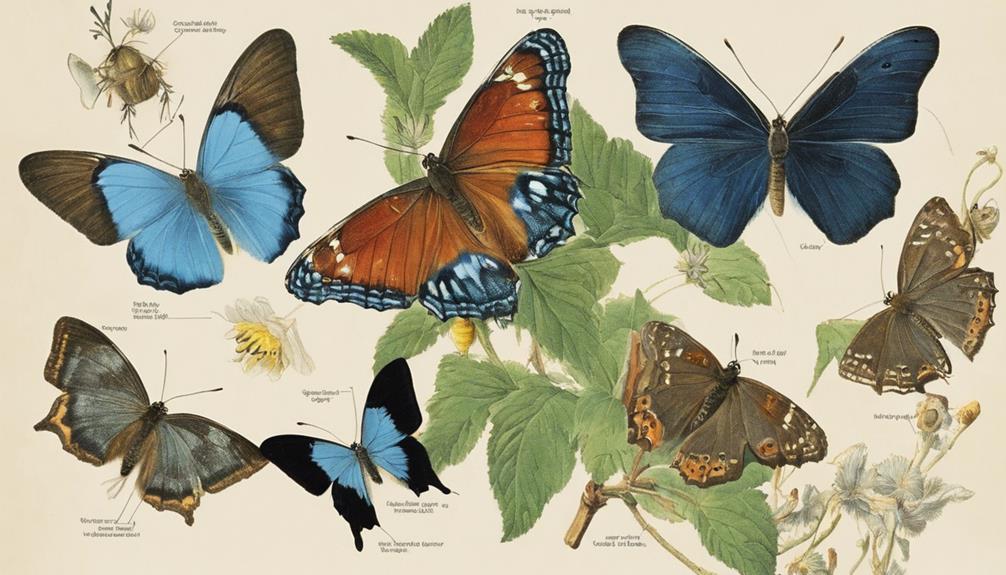
When you look at the Alcon blue butterfly‘s life cycle, you’ll notice its unique strategy of getting adopted by ants, a behavior distinct from other butterflies. These caterpillars use mimicry to blend in with ant larvae, relying on the ants for care and protection. Unlike typical butterflies that fend off predators directly, Alcon blues use this “cuckoo” tactic, emerging as adults after a safe development period in ant nests.
Ant Adoption Strategies
In their quest for survival, the caterpillars of the Alcon blue butterfly employ fascinating ant adoption strategies, seamlessly integrating into Myrmica ant nests. By exhibiting brood parasitism, these caterpillars trick Myrmica ants into adopting them.
They achieve this through remarkable mimicry, imitating ant larvae to gain access to the secure environment of the ant nest where they can develop and pupate. Once inside the ant nest, Alcon blue caterpillars adopt strategies that secure their survival. They either act like cuckoos, relying on the ants to care for them, or they take on a predatory role, feeding on the ant larvae.
The key to their successful integration lies in their ability to mimic the queen ant. This evolutionary adaptation is essential, as it allows the caterpillars to be accepted and nurtured by the ant colony.
The unique adoption strategies of Alcon blue butterflies underscore their complex evolutionary adaptations. Their ability to deceive and integrate into ant nests showcases a sophisticated survival mechanism, highlighting the intricate interplay between species in nature. By understanding these strategies, you can appreciate the extraordinary lengths to which Alcon blue butterflies go to secure their survival.
Predator Vs. Cuckoo Tactics
Two primary survival methods define the life cycle and behavior of Alcon blue butterflies: predator and cuckoo strategies. By understanding these methods, you can better appreciate how these butterflies interact with their host ant species and the implications for their persistence and reproductive success.
Predator caterpillars of Alcon Blue butterflies are aggressive. They infiltrate ant nests and consume the larvae of their host ant species. This predatory behavior secures a rich protein source, boosting their chances of survival. On the other hand, cuckoo caterpillars rely on mimicry and trickery.
They deceive host ants into believing they’re one of their own, often by imitating ant larvae or emitting chemical cues. This allows them to be adopted and cared for by the ants, securing their place within the nest without the need for aggressive tactics.
Understanding these behavioral differences is essential for conservation efforts. By knowing which strategy a population of Alcon Blues employs, conservationists can effectively tailor their approaches to protect these unique butterflies.
- Predator caterpillars: Actively consume host ant larvae.
- Cuckoo caterpillars: Rely on mimicry and trickery to be cared for by ants.
- Survival and reproductive success: Dependent on the chosen strategy and host ant species.
These methods highlight the intricate and captivating survival strategies of Alcon blue butterflies.
Adult Emergence Timing
The timing of adult appearance in Alcon Blue butterflies is a key aspect of their life cycle and behavior. These butterflies typically appear as adults in mid-to late summer, which is important for their mating behavior and population dynamics.
This specific timing guarantees that adults are synchronized for mating and that their eggs have ideal conditions for development. Understanding adult appearance timing is essential for conservation efforts and habitat management.
For example, if you’re aiming to support Alcon Blue populations, knowing when they appear can help you protect important habitats during sensitive periods. Variations in this timing across different regions can greatly impact the success of Alcon Blue populations, as mismatches with environmental cues or host plant availability could lead to population declines.
Research insights into the factors influencing adult appearance timing offer a deeper understanding of the biology and behavior of Alcon Blue butterflies. By studying these factors, researchers can develop better strategies for conservation efforts.
For instance, if climate change shifts appearance times, habitat management practices may need to adjust accordingly to ensure that Alcon Blue butterflies continue to thrive. So, keeping an eye on appearance timing is crucial for their long-term survival.
Host Ant Interactions
Alcon Blue butterflies have a fascinating survival strategy that relies on their interactions with specific host ants, particularly Myrmica scabrinodis, during their larval stage. As larvae, Phengaris alcon (or Maculinea alcon) deceive worker ants into accepting them into the ant nest by mimicking the ant larvae.
This deceptive relationship turns them into brood parasites, allowing them to be fed and protected as if they were genuine ant larvae. Once inside the ant nest, the Alcon Blue larvae benefit from the care provided by the worker ants, which secures their survival and development. The worker ants, unaware of the ruse, treat the caterpillars as part of their brood, feeding and tending to them diligently.
- Larvae imitate ant larvae: The caterpillars produce chemicals that replicate the scent of ant larvae.
- Host ant variation: Different populations of Alcon Blue may prefer different Myrmica species.
- Survival strategy: The caterpillars’ mimicry and integration into ant nests are essential for their development.
Understanding these host ant interactions is vital for protecting Alcon Blue populations, as their survival depends heavily on the intricate relationship with their specific host ants.
Conservation Status

Understanding the intricate relationship between Alcon Blue larvae and their host ants underscores the butterfly’s delicate existence. The Alcon Blue butterfly (Phengaris alcon) is classified as endangered, primarily due to habitat loss and isolation.
These factors, coupled with changes in habitat management, severely threaten their survival. Conservation efforts are vital to protect these unique populations across Europe. Phengaris species, including the Alcon Blue, are high on the list of butterfly conservation priorities in Europe.
This is due to their ecological variations and high parasitization rates. The Alcon Blue’s specialized habitat requirements make it particularly vulnerable to environmental changes. When habitats are fragmented or lost, butterfly populations become isolated, reducing genetic diversity and increasing the risk of extinction.
Genetic studies are recommended to explore possible cryptic speciation within Alcon Blue populations. Understanding these genetic differences is crucial for developing effective conservation strategies. By focusing on the geographic distribution and conservation concerns of the Alcon Blue butterfly, you can implement targeted efforts to safeguard these delicate creatures.
Protecting their habitats and ensuring connectivity between populations are key steps in preventing their decline and ensuring their long-term survival.
Scientific Research and Discoveries
In recent years, scientific research has unearthed fascinating insights into the life cycle and survival strategies of the Alcon Blue butterfly. Like other large blues, Alcon Blue butterflies rely on ants to rear their young through a remarkable process known as brood parasitism.
Scientific studies have revealed that Alcon Blue caterpillars exhibit intricate mimicry and survival strategies within ant nests, including the ability to mimic ant queen behavior, which guarantees they receive preferential treatment. Discoveries about the genetic differentiation and chemical coevolution of Alcon Blue butterflies have significantly advanced our understanding of their ecological interactions.
These butterflies have evolved unique adaptations to fit into their specific environmental niches. For example, the caterpillars produce chemical signals that closely resemble those of ant larvae, fooling the ants into accepting and nurturing them.
- Genetic differentiation: Research has shown distinct genetic markers that aid in distinguishing Alcon Blue butterflies from other species.
- Chemical coevolution: The intricate chemical mimicry between Alcon Blue caterpillars and their host ants showcases coevolution at its best.
- Ecological interactions: Understanding these interactions is pivotal for conservation efforts aimed at preserving these unique butterflies.
Conservation efforts are increasingly informed by these scientific discoveries, highlighting the importance of preserving both the butterflies and their host ant species.
Frequently Asked Questions
What Is the Lifespan of the Alcon Blue?
The Alcon blue butterfly’s lifespan is 2-3 weeks. During this time, you’ll observe intense mating habits. Understanding their behavior, habitat, and predators helps in conservation efforts and monitoring population trends. Migration isn’t significant in their lifecycle.
What Are Some Interesting Facts About the Alcon Blue Butterfly?
You’ll find the Alcon blue butterfly fascinating due to its unique habitat preferences, intricate mating behavior, and larval stage inside ant nests. Conservation efforts are crucial since predators and threats endanger its survival. Migration patterns are also limited.
How Did the Dutch Alcon Blue Butterfly Go Extinct?
The Dutch Alcon blue butterfly went extinct due to habitat loss, pesticide use, lack of host plants, climate change, predation pressure, competition with other species, and disease outbreaks. Human-induced changes doomed its delicate ecosystem and local adaptations.
What Species of Plant Must Female Alcon Blue Butterflies Lay Their Eggs On?
You need to know that female Alcon Blue butterflies must lay their eggs on Marsh Gentian flowers. These host plants are crucial for their reproductive behavior, egg laying, larval development, and overall habitat requirements, ensuring successful conservation efforts for this butterfly species.
Conclusion
In understanding the Alcon blue butterfly, you’ve seen its distinctive reliance on the Marsh Gentian that sets it apart from other large blue species. This unique bond underscores the importance of targeted conservation efforts. Unlike other species, the Alcon blue’s specialized ecological interactions and life cycle intricacies make it an extraordinary subject of study. By focusing on these unique characteristics, you can help secure the survival of this endangered butterfly.
Discover More Articles:
What Do Earwigs Eat? Insights and Actions to Protect Your Garden
How to Get Rid of Earwigs in the Garden Quickly in Your Garden
