

Termite Queen: Reproductive Wonder of the Insect World
Imagine encountering a termite queen, a creature up to 6 inches long with a translucent body. You might wonder how such a unique insect impacts a termite colony with a lifespan of up to 50 years.
Her primary role lies in her impressive egg-laying capacity, which reached its peak for a decade and ensured the colony’s proliferation.
Understanding her role is vital, but how exactly does one locate and eliminate this elusive queen to control infestations? Finding and managing a termite queen is more complex than you might think.
Key Takeaways
- The termite queen can grow up to 6 inches long and has a pale or translucent body.
- She has an enlarged abdomen, enabling continuous egg production for up to 50 years.
- The queen’s pheromones regulate colony behavior and development, which is crucial for sustained success.
- Specialized chambers within the nest house the queen for optimal egg-laying conditions.
- Professional pest management is essential for effectively locating and eliminating the queen to control the colony.
Termite Queen Appearance
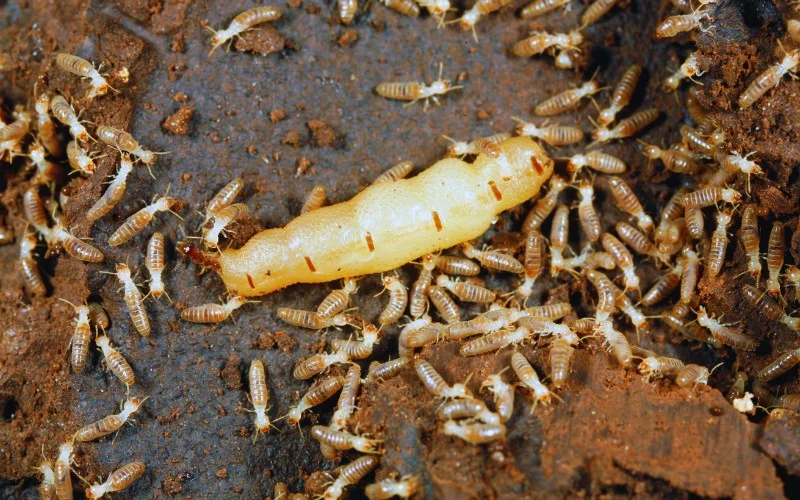
The termite queen‘s appearance is striking, with her body often growing up to 6 inches long. Unlike the smaller worker termites, her elongated body shape sets her apart immediately.
Her color is usually pale or translucent, making the queen stand out from the darker workers. This unique termite appearance isn’t just for display; it plays an essential role in the colony’s survival and reproductive success.
Deep within the nest, you’ll find her in specialized breeding chambers, a secure environment where she can lay thousands of eggs. The queen’s size is a direct result of her reproductive role.
Her enlarged abdomen is packed with ovaries, allowing her to produce a constant stream of eggs. This remarkable capacity ensures the colony’s growth and sustainability.
Her distinctive elongated body shape and immense size make her easily recognizable to the worker termites, who tend to her needs and ensure her safety. These physical traits are crucial for her function and the overall health of the colony.
Size of the Termite Queen
When considering the termite queen‘s role, her impressive size, often reaching 6 inches, becomes a key factor in the colony’s survival. You might find it surprising that queen termites can grow to the size of a human index finger, a stark contrast to the much smaller worker termites.
This substantial growth is primarily due to her egg production capabilities, crucial for maintaining and expanding the termite colony.
The queen’s body is typically pale or translucent, making her quite distinct from the other members of her colony. Her significant size results from her specialized role in continuous egg-laying, essential for the colony’s success.
Unlike the mobile worker termites, the queen remains immobile, residing deep within the colony’s breeding chambers. This protected environment ensures her safety and allows her to focus solely on reproduction.
The size of the termite queen isn’t just a biological marvel; it’s a critical adaptation for the survival of the termite colony. Her ability to produce thousands of eggs contributes to the colony’s growth and longevity, guaranteeing that the termite population remains robust and thriving.
Queen Termite Lifespan
Earning her title as the longest-living member of the colony, the termite queen can live an astonishing 25 to 50 years. This incredible termite queen lifespan guarantees long-term stability and growth for the entire colony.
Her longevity is a cornerstone of the colony’s health, as she continuously produces offspring and supports rapid expansion. It is fascinating that the queen termite’s peak egg production can last up to 10 years.
She lays eggs remarkably during this time, ensuring the colony’s rapid growth. As a result, the termite queen’s reproduction process is crucial for maintaining a robust and thriving colony.
When the queen termite eventually dies, her importance doesn’t wane. Instead, the colony has mechanisms to ensure its continuity.
A new queen develops to take her place, ensuring reproductive continuity and stability. Additionally, the queen’s death triggers the production of secondary reproductives, further maintaining the colony’s health and longevity.
Despite her advanced age, the queen termite remains larger than worker termites, indicating her importance in the colony hierarchy. The longevity and reproductive capabilities of the termite queen are essential for the sustained success and expansion of the colony.
Egg-Laying Process
Imagine the termite queen meticulously selecting the perfect spot within the colony to lay her numerous eggs each day. She chooses areas with ideal temperature and humidity levels, ensuring the eggs’ viability and the colony’s future.
The queen carefully lays each egg using her ovipositor, a process essential for colony expansion. Once the eggs are laid, worker termites spring into action. They tend to the eggs and maintain ideal conditions for their development.
These diligent workers ensure that each egg is well cared for until it hatches into larvae. Here’s a breakdown of the egg-laying process:
| Step | Description |
|---|---|
| Queen’s Selection | Queen selects the ideal location within the colony |
| Egg-Laying | Queen uses ovipositor to lay eggs |
| Worker’s Role | Workers tend to the eggs, safeguarding their viability |
The continuous egg-laying by the queen is essential for the growth and sustainability of the termite colony. Without her relentless effort, the colony wouldn’t survive or expand.
The worker termites’ care and attention to the eggs underscore the importance of teamwork in maintaining the colony’s health and ensuring its future success.
Role in the Colony
The termite queen plays a central role in guaranteeing the colony’s growth and survival through her relentless egg-laying and pheromone emission. She lays thousands of eggs daily, crucial for maintaining the colony’s population.
The queen’s pheromones regulate the behavior and development of other termites, ensuring everyone knows their role. These chemical signals maintain social cohesion and reproductive control, allowing the colony to function smoothly.
Her life in the royal chambers is one of constant activity and care. Worker termites are dedicated to feeding, cleaning, and protecting her. They ensure she remains healthy and capable of fulfilling her primary role of laying eggs.
If the queen dies, it’s a critical moment for the colony. The loss of her pheromones triggers the development of secondary reproductives, who can take over her egg-laying duties to guarantee the colony’s survival.
The queen’s presence and productivity in the royal chambers are crucial. Without her, the colony would struggle to maintain its structure and growth. Her role is indispensable, making her the linchpin of termite society.
Primary Reproductives
Primary reproductives like the queen, king, and alates are essential for establishing and sustaining new colonies in a termite colony. The queen has a critical role in starting the egg-laying process, which is crucial for producing the worker caste.
These workers are responsible for expanding the nest and caring for the queen, ensuring she’s the support needed for her continuous egg-laying. Without a queen, the colony wouldn’t have the necessary workforce to thrive.
The king, another primary reproductive, stays by the queen’s side, aiding the reproductive process and maintaining the colony’s stability. Together, the queen and king form the foundation of the termite society.
Alates, future primary reproductives, are winged termites that leave the nest during swarming events. Their mission is to mate and establish new colonies, continuing the species’ lifecycle.
When conditions are right, these alates will shed their wings, pair up, and start new colonies, becoming the next generation of queens and kings. Each plate has the potential to become an essential part of a new colony, contributing to the growth and expansion of termite populations.
Secondary Reproductives
Secondary reproductives support colony growth, especially when the primary queen’s influence wanes. These light-colored termites are important in guaranteeing the colony’s survival and expansion.
When the queen’s pheromones, which typically inhibit their development, diminish or cease due to her death, secondary reproductives mature and take over reproductive duties. This change is essential for the colony to continue thriving.
Here are three key points about secondary reproductives:
- Colony Expansion: Secondary reproductives help in colony expansion by establishing satellite nests. These nests are extensions of the main colony and contribute to its growth.
- Inhibitory Pheromone: The queen’s pheromones act as inhibitory pheromones, preventing the development of secondary reproductives until she can no longer maintain dominance.
- Species Adaptation: Numerous secondary reproductives are common in species like Reticulitermes. This strategy ensures the colony remains robust even if the primary queen is lost.
Finding Termite Queens
Locating termite queens requires specialized knowledge and equipment due to their deep, hidden chambers within the colony. These queens are usually found deep within the colony, protected by worker and soldier termites.
They rarely venture outside their nest, making them elusive targets. Understanding the colony’s growth patterns and structure is vital for finding queen and king termites. Professional pest management services have the expertise and tools to locate these hidden monarchs.
They use advanced techniques to pinpoint the queen’s chamber, which is essential since the queen’s location varies depending on the colony’s size and age. The queen’s role is significant as she continues laying eggs, ensuring the colony’s growth and survival.
Here’s a quick overview:
| Factor | Description | Importance |
|---|---|---|
| Depth of Nest | Deep within the colony | Hard to locate without expertise |
| Queen’s Role | Continuous egg-laying | Critical for the colony’s growth |
| Professional Assistance | Specialized tools and knowledge | Essential for locating queens |
Finding the queen termite is challenging but important in understanding and managing a termite infestation. Pest management professionals can offer more effective solutions tailored to the colony’s specific structure by focusing on the queen.
Eliminating the Queen
Getting rid of the queen termite can be challenging, but it’s not always necessary for effective colony control. Queen termites are pivotal for egg production, but targeting them directly is often impractical.
Instead, you can focus on thorough treatment methods to achieve colony eradication. Here are three effective strategies:
- Termiticides and Soil Treatments: These methods disrupt the colony’s ability to sustain itself, reducing the need to locate the elusive queen. By creating a barrier around your property, you can prevent termites from re-entering.
- Baiting Systems: Baits are designed to attract worker termites, carrying the toxic substance back to the colony. This method gradually poisons the entire colony, including the queen, without having to find her.
- Professional Pest Management: Experts have the knowledge and tools to assess the infestation and recommend the most effective treatment plan. They understand that eliminating the queen termite can sometimes trigger the development of secondary queens, complicating colony eradication.
Professional pest management services offer invaluable expertise in dealing with termite infestations. They don’t rely solely on removing the queen but use a holistic approach to ensure the entire colony is effectively controlled.
Conclusion
By understanding the termite queen’s pivotal role, you can better appreciate the complexity of termite colonies. Her unique appearance, impressive size, and remarkable lifespan make her essential for the colony’s survival.
Recognizing her egg-laying prowess and influence over primary and secondary reproductives helps you grasp the importance of locating and eliminating her to control infestations. Professional pest management is key to tackling this critical task and ensuring your home remains termite-free.
Explore More Articles:
The Secret Life of Gall Wasps: Small Wonders of the Insect World
Home Remedies for Earwig Infestation: Effective Natural Solutions
