

Why Bugs are Drawn to Light: Exploring the Attraction
Insects gravitate towards light due to their natural navigational instincts. This draws them towards illumination sources like the moon and stars, which serve as compasses in the dark.
However, artificial lights disrupt this age-old navigation system, causing insects to circle endlessly or become entrapped. Discover why this seemingly simple behavior is a complex interplay between biology and environment.
Insects are attracted to artificial illumination sources, such as lights at night because they try to orient themselves along an up-and-down axis when they see a bright light. This instinct can cause them to roll their backs toward the light, leading to endless banking turns or crashes.
The Science Behind Why Bugs Are Drawn to Light
On warm summer nights, it’s common to see moths and other flying insects spiraling wildly around bright lights, seemingly unable to pull themselves away. But what captivates these tiny creatures about these artificial sources of illumination?
Biologists Samuel Fabian and Yash Sondhi propose a new explanation for this attraction, rooted in the insects’ innate navigational instincts. Insects have evolved to use natural light sources, such as celestial bodies or sky brightness, to determine direction over millions of years.
It’s their way of staying level during flight, similar to how sailors use stars to find the north star. The moon and stars help these creatures navigate straight lines towards their destination. However, they become disoriented when they encounter artificial lights at night as their instinctual navigation system becomes hijacked.
This disorientation can cause them to spiral endlessly or become trapped within the light source. This behavior isn’t just inconvenient for bugs but can also be hazardous.
Imagine driving through a dense fog where you lose your sense of spatial orientation. Insects experience something similar when they encounter artificial light sources at night.
While the theory that insects confuse artificial lights with celestial bodies or mistake them for daylight filtering through vegetation is popular, Fabian and Sondhi’s work challenges these long-held beliefs. Their proposition sheds light (pun intended) on an entirely new perspective on this age-old enigma.
Natural vs. Artificial Attraction Sources for Insects
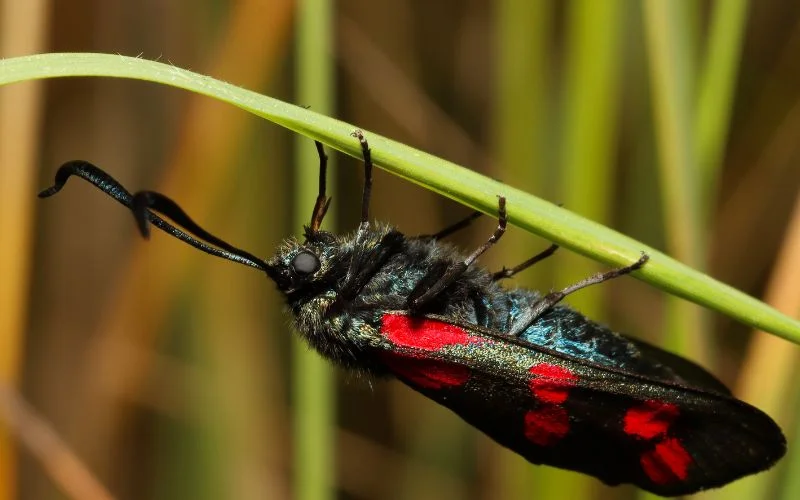
In the grand tapestry of evolution, insects have coexisted with natural light sources like the moon and stars for millennia. These light sources helped guide their flight patterns and even played a role in matters of reproduction.
However, insects face an unprecedented and challenging environmental shift with artificial lighting, particularly streetlights and indoor illumination.
Natural light sources emit visible and ultraviolet wavelengths that insects have adapted to over time. For instance, the moon’s light indicates directionality – its brightness and position guide flying insects during nocturnal navigation.
This is particularly crucial for insect species that rely on the moonlight to locate potential mates or feeding grounds. Similarly, stars offer celestial cues and contribute to insect behavior by mimicking a continuous light point.
For many insects, this serves as a helpful reference point in maintaining their flight paths during migration or daily activities. Conversely, artificial light sources often exhibit distinct characteristics and different wavelengths than natural light.
Streetlights and indoor lighting are notorious for emitting bright, steady light that can disorient flying insects. This stark contrast to natural light’s subtle, variegated glow can disrupt their behavior.
Impact of Different Light Sources on Insect Behavior
Observing insects’ response to different colors and intensities is fascinating when considering their attraction to light. White and ultraviolet lights tend to be the most attractive to insects. This means that when you have these lights outside, you’re likely to have more bugs swarming around them.
Conversely, yellow, orange, and red lights are less appealing to insects. Therefore, to reduce the number of bugs buzzing around your external lighting fixtures, consider changing the bulbs to those with warmer tones.
But why do insects show this preference for certain types of light? Well, there are a few reasons. For one, many insects use the sky’s polarized light pattern as a navigational aid, and bright artificial lights can disrupt this guidance system.
When insects fly at night, they rely on the most colorful part of their visual field (usually the sky) as a reference for orientation. Artificial point light sources can confuse insects into tilting away from the sky and disrupt their flight stability.
Moreover, besides attraction responses, different light sources can also affect insect health. Studies have shown that exposure to certain types of light can disrupt insect behaviors such as mating, foraging, and predator avoidance.
This disruption may consequently affect insect populations and contribute to declines due to light pollution affecting ecosystems. It’s not just about navigation, though – some types of light mimic the conditions insects reproduce under.
For instance, certain bugs are drawn to ultraviolet light because it resembles moonlight—something they might mistake artificial lights for. This can lead them away from their natural habitats, making it more difficult to locate suitable environmental conditions.
Exploring Various Theories of Light Attraction
The fascination surrounding why insects are drawn to light has spurred numerous theories. One widely accepted notion suggests that insects mistake artificial lights for celestial bodies or confuse them with daylight filtering through vegetation.
However, new research challenges this long-held belief and offers a fresh perspective on this intriguing phenomenon. Biologists Samuel Fabian and Yash Sondhi proposed a fascinating new explanation for insects’ attraction to bright lights.
Their theory suggests that insects instinctively attempt to orient themselves along an up-and-down axis when encountering a strong light source, as if trying to align with the sky. This innate behavior causes them to roll their backs toward the light, resulting in erratic flight patterns and potentially even crashes.
The “Roll and Crash” Theory
According to Fabian and Sondhi’s findings, insects’ directional instincts, which typically assist them in staying level by keeping their backs pointed towards sunlight during flight, appear to be hijacked by artificial lights at night.
What was once believed to be a case of attraction or confusion now presents itself as a matter of instinctual disorientation, shedding new light on these tiny creatures’ peculiar behavior.
Since a dedicated scientific inquiry into this subject began, multiple theories have emerged attempting to elucidate why insects demonstrate this peculiar phototactic behavior. Some propose that artificial lights disrupt insects’ navigation systems.
Others, in contrast, suggest that insects are naturally drawn to ultraviolet (UV) light because it resembles natural nighttime sources such as the moon.
Impact on Circadian Rhythms
Ecologists are concerned about the potential impact of artificial lights on insect circadian rhythms, which govern their behavior during day-night cycles. Considering how these theories might be intertwined with the fundamental biological mechanisms that influence insect behavior is imperative.
As we uncover more about the enigmatic allure of light for insects, it becomes clear that there is no single explanation for this complex phenomenon. Instead, it appears to be a collective interplay of various instinctual responses and environmental cues that drive insects toward artificial illumination sources.
What Causes Insects to be Drawn to Light?
Insects attracted to light may be drawn to it due to phototaxis, where they navigate by light sources. Some are drawn to ultraviolet light, mistaking it for the sun or moon.
Others may use light for orientation or navigation. This behavior can be useful in trapping and monitoring insect populations.
Investigation of Unusual Reasons for Attraction to Light
Scientists have long puzzled over insects’ instinct to orient themselves along an up-and-down axis. However, new hypotheses suggest that the behavior is more complex than previously thought.
Biologists Samuel Fabian and Yash Sondhi propose that when insects see a bright light, they believe it is the direction of the sky and attempt to orient themselves in response.
This instinctive behavior can lead them to roll their backs toward the light source, causing them to engage in endless banking turns or even experience crashes.
To prove this theory, further studies must observe how insects react in controlled environments and natural settings. For example, researchers can use simulated sky projections to test if insects exhibit the same behaviors in response to artificial illumination sources.
By observing these reactions, scientists can clarify the correlation between insect orientation and their attraction to light. More research and peer review are needed to confirm these findings.
In summary, investigating unusual reasons for insects’ attraction to light illuminates the complex relationship between insect behavior and external stimuli.
By exploring these lesser-known avenues, scientists inch closer to unraveling one of nature’s enduring mysteries—the allure of light for nocturnal insects.
Potential Ecological Impacts of Light Attraction

The interaction between insects and artificial light has implications beyond mere curiosity or nuisance. The effect of light attraction on insect populations extends to complex ecological dynamics.
Light pollution from human-made sources can disrupt natural ecosystems, altering the behavior and survival of nocturnal insects. Let’s first consider the impact of light attraction on this behavior, which is crucial for their survival.
Artificial lighting can disrupt the natural rhythms guiding insect behavior at night. Some insects may become disoriented and spend more time near artificial lights, neglecting essential activities such as foraging and mating.
Implications for Conservation Efforts
Understanding the potential ecological impacts of light attraction on insects is essential for conservation efforts. As we expand urban areas and continue to increase our reliance on artificial lighting, it becomes imperative to mitigate the disruptive effects of light pollution on insect populations.
This knowledge underscores the importance of implementing measures to reduce light pollution, such as using shielded outdoor lighting fixtures and minimizing excessive nighttime illumination. By adopting these practices, we can create environments more conducive to maintaining the delicate balance within ecosystems and preserving biodiversity.
Understanding the intricate impact of light attraction on insect populations is critical for maintaining our ecosystems’ delicate balance and preserving biodiversity. Implementing measures to minimize light pollution is vital for the sustained coexistence of various species in our environments.
FAQs
Can bug behavior towards light be manipulated or used for practical purposes?
Yes, bug behavior toward light can be manipulated and used for practical purposes. We can create more effective pest control methods by understanding the mechanisms behind their attraction to light.
For instance, by using specific wavelengths of light and strategically placing insect traps, we can attract and capture pests like mosquitoes and fruit flies, reducing the need for chemical pesticides.
Are there any benefits for bugs in flying towards light sources?
Bugs are not naturally attracted to artificial light sources, as they disrupt their natural behaviors and can even prove detrimental. Flying towards lights can result in insect population declines by causing increased predation, disruption of mating patterns, and interference with feeding and reproductive activities.
Are there any potential risks or dangers associated with bugs being attracted to lights?
Yes, there are potential risks and dangers associated with bugs being attracted to lights. One major concern is that insects drawn to lights can disrupt ecosystems, as they can divert from their natural behaviors, become vulnerable to predators, or end up in unfamiliar habitats. This can subsequently affect the food chain and pollination patterns.
Explore More Articles:
Termites Swarming: Identifying and Preventing Infestations
